
The short answer
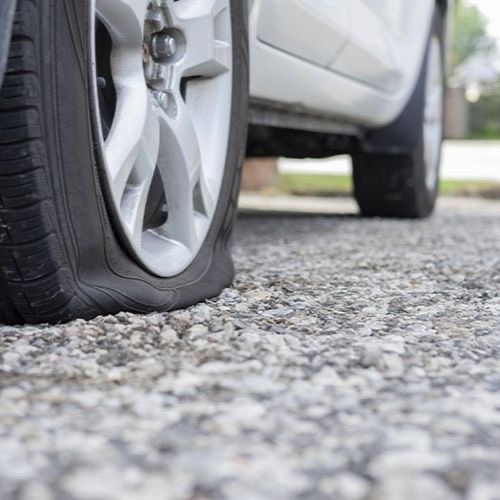
If you've got a flat tyre and no spare, your three options are: a tyre sealant kit (works for small tread punctures only), a run-flat that's already getting you home, or a phone call to a mobile fitter. Don't keep driving on a deflated standard tyre — past about a mile, you're scrap-binning the tyre and probably the wheel.
Roughly two-thirds of new cars sold in the UK come without a spare. That's a deliberate manufacturer trade-off — saved weight, better fuel economy or EV range, more boot space — and it's fine until the first puncture, which is when most people discover what's actually in the boot.
First: figure out what you've got
Open the boot floor and look under it. You'll find one of four things.
- A full-size spare wheel. Best case. Swap it on, drive carefully, get the puncture sorted as soon as possible.
- A space-saver (narrow) spare. Smaller, narrower, typically rated for 50 mph max and around 50 miles of use. Fine to get you to a fitter — not fine for a long motorway run.
- A tyre sealant / inflator kit. A bottle of sealant goo and a 12V compressor. Works for small tread punctures only — useless for sidewall damage, a blowout, or a hole bigger than ~6mm.
- Nothing. Manufacturers increasingly assume you'll just call someone. Charming.
If you're not sure which you've got, look now, not when you're at the side of the A580 in the rain.
When the sealant kit works (and when it doesn't)
The kit is designed for one specific scenario: a small puncture in the central tread area of the tyre, where a nail or screw is the cause.
It works for:
- Small holes, typically under 4–6mm.
- Holes in the central tread (not the shoulder, not the sidewall).
- Slow leaks where the tyre is mostly inflated.
It does not work for:
- Sidewall damage (rips, cuts, gouges).
- Bigger holes (anything larger than ~6mm).
- Blowouts where the tyre is shredded.
- Tyres that have been driven on flat — the internal damage is already done.
Important: a sealant repair is a temporary, get-home-only fix. Most kits explicitly say "up to 50 miles" and require a permanent BSAU 159 repair (or a replacement) within that distance. Sealant also writes off the tyre for a future plug-and-patch repair — the goo contaminates the inside of the tyre and a fitter can't bond a proper patch to it. Use the kit and the tyre is going in the bin.
What you should NOT do
A few things to avoid:
- Don't drive far on a fully deflated tyre. Standard radial tyres are not designed to support the car's weight unaired. Within a mile you'll destroy the sidewall, often the bead, and frequently the alloy itself. Pull over and stop, don't push it the next two junctions to "find somewhere safer".
- Don't try to keep driving on a run-flat past its stated range. Run-flats are designed for ~50 miles at ~50 mph after a puncture. Beyond that the stiff sidewall starts to delaminate. They give you margin, not infinite forgiveness.
- Don't fit a different-size emergency wheel and assume the car will behave the same. The traction and stability systems are tuned to matched tyres. Drive gently to the fitter.
- Don't pull a string-plug repair kit out of the boot and stab it through from the outside. It's not a BSAU 159 repair. We've seen these on three-month-old "fixes" that have failed at 70 mph. If a previous owner left one in your boot, bin it.
When to call a mobile fitter
If you've got no spare and the sealant kit isn't appropriate (sidewall damage, big hole, already driven on flat, blowout), that's a call. We cover:
- Wigan and Bolton areas with full mobile tyre fitting — see Mobile Tyre Fitting Wigan and Mobile Tyre Fitting Bolton.
- 24/7 emergency response — see Emergency 24/7 Tyre Fitting.
- Motorway emergencies on the M6 J21–J26 and M61 J5–J6 — see Motorway Tyre Emergency. If you're on the motorway hard shoulder, ring National Highways on 0300 123 5000 first so they can protect the scene, then ring us.
What we do on a no-spare callout: assess what's actually wrong (sometimes a tyre that looks flat just has a slow leak that's repairable to BSAU 159), bring the right replacement tyre to you, fit and balance on the driveway or layby, get you back on the road. A typical call-out is 25–45 minutes of fitting plus the time it takes us to reach you.
What we don't carry: every tyre size for every car. Common sizes we have on the van. Rare sizes — performance tyres, specialist EV tyres, motorhome sizes — sometimes need a same-day collection from a depot. We'll tell you on the phone, not after we've turned up.
Why so many new cars have no spare
Three reasons, all manufacturer-side:
- Weight saving for fuel economy and EV range. A full-size spare and jack add 15–25 kg.
- Boot space — flat boot floors with no spare well sell better.
- EU CO2 targets — every kilo counts toward fleet emissions averages.
Whether you can fit a spare yourself: sometimes. There are aftermarket "puncture-rescue wheel" kits sized to common space-saver hubs. They're not crash-tested with your car, the boot well usually isn't designed for one, and you're typically over the manufacturer's load limit. Talk to a fitter or your dealer first.
Frequently Asked Questions
Can I just keep using sealant kits forever?
No — sealant kits are designed for one-time, get-to-the-fitter use. The tyre is then replaced (or properly repaired to BSAU 159 if the damage permits, which is rare after sealant). Repeat use isn't safe.
Is it legal to drive with no spare in the UK?
Yes — there's no UK legal requirement to carry a spare. The manufacturer decides. What's legally required is that all four fitted tyres meet the minimum tread depth (1.6mm) and are free of significant damage.
What about caravans and motorhomes — do they have spares?
Most caravans don't (the spare is an option from the dealer). Most motorhomes do, but it's often under the chassis on a winch and accessing it is a hassle. See caravan and motorhome tyres for the practical detail.
Will my insurance cover a mobile fitter call-out?
Some breakdown policies (AA, Green Flag, RAC, manufacturer-bundled cover) include tyre callout as part of standard cover. Others don't. Worth checking your policy before you need it — and remember, even if recovery is covered, you'll usually still pay for the tyre itself.
What if I'm on the motorway with no spare?
Get off the carriageway onto the hard shoulder, exit the vehicle, get behind the barrier, ring National Highways on 0300 123 5000, then ring a mobile fitter. Don't change tyres on the hard shoulder yourself — that's not safe. Detailed safety walkthrough on the Motorway Tyre Emergency page.
Sources
- National Highways — what to do in a breakdown
- BSI Group — BS AU 159 (puncture repair standard)
- UK Government — driving with worn or damaged tyres
Written and reviewed by the Breakdown Man team. Last reviewed for accuracy on 2026-05-15.
Need a hand right now? Call 07549 676 220 for mobile tyre fitting across Bolton and Wigan. Quotes by phone — every job is different.

