

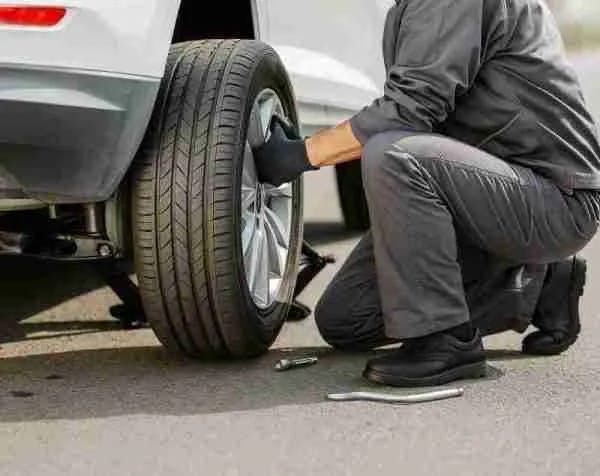
The short answer
A single mobile tyre swap on a driveway usually takes 20 to 40 minutes from the moment we park up. A full set of four is 60 to 90 minutes. Add 10–20 minutes if it's a run-flat, the locking wheel-nut key is missing, or the TPMS sensors need re-registering.
That's the headline. The honest version below covers the things that actually push the timer.
What's happening in those 20–40 minutes
For a standard car tyre on a sound alloy we're doing this:
- Park up, chock the opposite wheel, check the tyre size and load/speed rating against what's coming off (~2 minutes).
- Crack the wheel nuts on the ground, jack the car on the manufacturer's lift point, support on an axle stand where there's room (~3–5 minutes).
- Break the bead, demount the old tyre, inspect the rim for corrosion or cracks (~5 minutes).
- Fit the new tyre, seat the beads, balance the wheel on the mobile balancer (~8–12 minutes).
- Torque the wheel nuts to the manufacturer's spec, refit any wheel cover, reset TPMS if needed, pack down (~5 minutes).
If everything is straightforward — no seized nuts, no TPMS faff, no rim corrosion — that's your 25 minutes.
What pushes the time up
A few real-world things slow the job down. We'd rather tell you up front than rush and miss them.
- Run-flat tyres. The stiffer sidewall takes more force to break the bead and seat. Expect an extra 10–15 minutes per corner. Run-flats are also less forgiving on rim condition. See our run-flat tyre fitting page for the detail.
- Missing or rounded locking wheel nut. If you've lost the key, we can usually get the nut off, but it takes time and sometimes a new locking nut set after. See locking wheel nut removal.
- TPMS resets. Most modern cars have a tyre-pressure monitoring system. Some learn the new sensor automatically after a short drive; others need a relearn procedure or a specific OBD tool. See TPMS sensor replacement.
- Seized lug nuts. Aluminium-onto-steel after a few winters can be brutal. We carry a 6-foot breaker bar and proper-fit sockets, but some nuts still need patience.
- Rim corrosion. Cleaning the bead seat properly so the tyre seals adds 5–10 minutes but it's the difference between a tyre that holds air for two years and a slow leak in a week.
- Caravans and motorhomes. Bigger, heavier, awkward access — typically 45–60 minutes per tyre. Caravan and motorhome tyres covers what we cover and what we don't.
What we don't cover
So you're not waiting on us when the job's not for us: we don't fit motorbike tyres, HGV/lorry tyres, or agricultural tyres. If that's what you need, it's a different fitter — happy to point you in the right direction if you ring us.
Response time vs. fitting time
Two different clocks. Response time is how long until we get to you. Fitting time is how long the job takes once we're there. We're Wigan-based (WN5), so:
- WN/BL postcodes: typically 20–45 minutes during the day, longer in rush hour or overnight.
- M6 J21–J26 / M61 J5–J6: see the motorway tyre emergency page for honest junction-by-junction expectations.
- Further out (Greater Manchester, parts of Lancashire and Cheshire): we'll give you a realistic ETA on the phone, not a 30-minute promise we can't keep.
Frequently Asked Questions
Can you do all four tyres in one visit?
Yes, as long as we can get the right sizes to you. We'll quote on the phone and confirm what's in stock or on a same-day delivery.
Will you fit tyres I've bought online?
We'll fit-only if you've already got them, yes. We'll check they match the size, load and speed rating on the placard inside the door — if you've ordered the wrong spec by accident, we'll flag it before we touch them.
Can you fit tyres in the dark or in the rain?
Yes. We work nights and weather doesn't usually stop us. Heavy rain on an alloy bead seat slows the job a touch because we clean and dry the surface before refitting.
How long does a puncture repair take vs. a full replacement?
A proper BSAU 159-compliant puncture repair (only valid in the central tread area, not the sidewall) is usually 25–35 minutes including the time to remove the wheel, inspect inside and out, plug-and-patch from the inside, and rebalance. See mobile puncture repair.
Do you need a flat driveway?
A reasonably level surface helps with the jack. A slope is workable. A soft verge or thick gravel is the only thing we'll usually ask you to move the car off, because the jack can sink and that's not safe.
Sources
- BSI Group — BS AU 159 (puncture repair standard)
- UK Government — driving with worn or damaged tyres (Highway Code & legal limits)
Written and reviewed by the Breakdown Man team. Last reviewed for accuracy on 2026-05-15.
Need a hand right now? Call 07549 676 220 for mobile tyre fitting across Bolton and Wigan. Quotes by phone — every job is different.

